
Living in Southwest Florida brings a unique set of challenges and responsibilities for homeowners, particularly when it comes to securing the largest access point of the house. As a dedicated local property specialist, I, Ethan Cole, have seen firsthand how the extreme coastal weather, intense UV rays, and high humidity in Fort Myers can accelerate wear and tear on heavy mechanical residential systems. Regular maintenance and adherence to strict safety standards are not just arbitrary recommendations; they are absolutely vital practices for protecting your home, your investment, and your family. By understanding the specific environmental needs of your property, you can drastically extend hardware lifespan, ensure optimal daily performance, and proactively prevent highly disruptive, costly emergency repairs.
The Importance of Hurricane Preparedness in Fort Myers
Fort Myers residents know all too well that hurricane season is an unavoidable reality that requires serious, proactive preparation. Your overhead garage door is highly vulnerable to extreme wind pressures, and a structural failure here can rapidly lead to devastating damage to your entire home. According to the stringent Florida Building Code and specific Lee County structural regulations, any new installation must meet rigorous, certified wind-load requirements designed to withstand hurricane-force winds and prevent catastrophic blow-ins.
When high-velocity winds strike the coast, a standard, non-reinforced structural barrier can buckle or detach from its tracks. This allows storm-force wind to enter the interior space, creating a massive buildup of internal pressure. This immense pressure often causes the roof to blow off completely and the supporting exterior walls to collapse outward. Upgrading to an impact-rated, hurricane-approved model or installing a certified retrofitting brace system is unequivocally one of the most effective ways to fortify your property against severe tropical storms.
“A compromised garage door is often the very first domino to fall in a catastrophic structural failure during a hurricane, making fully compliant, reinforced wind-load systems essential for all coastal residences.” – Guidelines derived from DASMA and Florida Building Code structural standards.
Essential Maintenance Guidelines for Optimal Performance
Consistent, preventative care is the primary secret to a smooth, quiet, and long-lasting mechanical system. The salty coastal air and intense tropical heat of Southwest Florida can cause unprotected metal parts to rust rapidly and rubber weatherstripping to degrade, crack, and fail prematurely. Conducting a thorough visual inspection and a comprehensive lubrication routine every few months will significantly reduce the grinding friction that severely strains your motor, tracks, and lifting springs.
Homeowners should begin by applying a high-quality lithium-based or silicone-based spray to all critical moving parts, including the steel hinges, metal rollers, and vertical tracks. It is imperative to avoid thick, heavy mechanical grease, as this material actively attracts local dust and sand, creating a highly corrosive paste over time. Furthermore, carefully inspect the heavy rubber bottom seal and the vinyl perimeter weatherstripping. The Department of Energy (DOE) emphasizes that maintaining airtight exterior seals not only keeps out storm debris and unwanted pests, but it also significantly improves your home insulation barrier, directly leading to lower monthly air conditioning costs.
Torsion Spring Safety and Lifespan
The heavy-duty torsion springs positioned above the opening bear the immense, crushing weight of the entire structural barrier, making them the most critical and potentially dangerous components of the entire lifting assembly. Under no circumstances should an untrained homeowner attempt to adjust, repair, or replace a high-tension torsion spring, as the tightly stored kinetic energy can cause severe bodily injury or even death upon sudden, uncontrolled release. The Consumer Product Safety Commission (CPSC) heavily advises relying strictly on certified, insured professionals for any spring-related modifications or emergency repairs.
Typically, a standard galvanized spring is rated for approximately ten thousand complete open-and-close cycles, which translates to roughly seven to ten years of average daily residential use. However, corrosive rust buildup from local coastal humidity can dramatically shorten this expected lifespan. If you notice a visible mechanical imbalance, where the barrier visibly struggles to open, groans under the load, or slams shut heavily against the concrete floor, it is crucial to schedule a professional diagnostic inspection immediately to prevent a sudden, catastrophic snap.
Modern Safety Features and Code Compliance
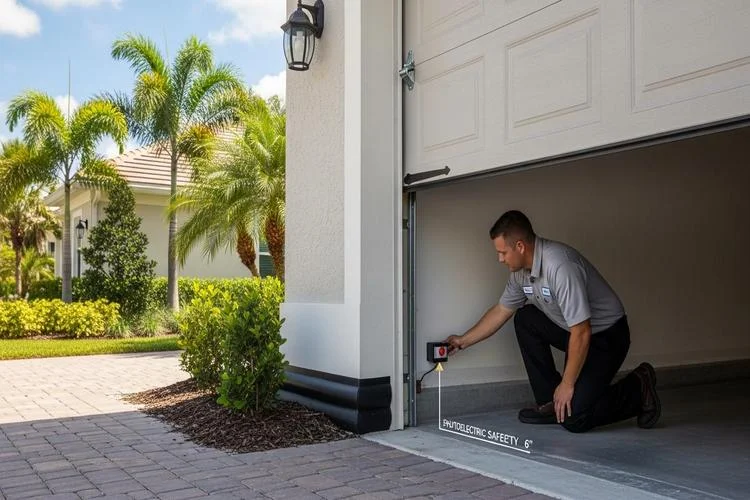
Ensuring that your automated electric opener functions safely is just as important as maintaining the heavy physical hardware. Since 1993, strict federal safety laws require all automatic lifting systems to feature functioning photoelectric eyes and automatic auto-reverse mechanisms to completely prevent dangerous crushing entrapment. These sensitive electronic sensors must be properly mounted no higher than six inches from the garage floor to effectively detect children, pets, or objects crossing the threshold during operation.
Testing the mechanical auto-reverse feature is a straightforward safety process that should be performed monthly by the homeowner. Simply place a solid object, such as a sturdy block of wood, flat on the ground directly in the path of the descending barrier. If the system does not immediately recognize the obstruction and reverse direction upon making contact with the object, the motor unit must be professionally serviced or completely replaced immediately to adhere to strict CPSC safety mandates. Additionally, the International Door Association (IDA) strongly recommends regularly checking the red emergency manual release handle to ensure you can quickly and safely disengage the carriage and manually operate the system during frequent Florida severe weather power outages.
Material Comparison for Coastal Environments
Choosing the correct replacement material is vital for long-term survival in the harsh Fort Myers climate. Homeowners must carefully balance exterior aesthetics, storm durability, and ongoing maintenance requirements. Selecting a robust material that actively resists coastal salt corrosion and intense UV warping will effectively save thousands of dollars in premature replacement and ongoing repair costs over the life of the property.
| Material Type | Durability in Coastal Climate | Maintenance Level | Energy Efficiency (DOE Aligned) |
|---|---|---|---|
| Steel (Galvanized and Painted) | High (if meticulously maintained to prevent surface rust) | Moderate (requires regular washing and protective waxing) | Excellent (when paired with dense polyurethane insulation) |
| Extruded Aluminum and Glass | Very High (naturally immune to red rust corrosion) | Low (routine cleaning of the glass panels and metal frame) | Poor to Moderate (glass easily transfers ambient exterior heat) |
| Natural Hardwood | Low to Moderate (highly prone to humidity warping and rot) | Very High (requires frequent sanding, sealing, and varnishing) | Moderate (possesses natural insulating properties but demands upkeep) |
| Composite Fiberglass | Exceptional (entirely resists salt corrosion and will not rot) | Low (simply needs occasional mild soap washing) | Good (frequently manufactured with highly insulated interior cores) |
Hiring the Right Professional in Southwest Florida
When the time inevitably comes for a full structural replacement or complex mechanical repairs, partnering with a highly qualified local technician is completely non-negotiable. Always rigorously verify that the contracting company you hire is fully licensed and adequately insured to perform structural work in Lee County, as non-compliant, unpermitted installations will instantly void manufacturer warranties and cause major legal issues during future home sales inspections. Property owners should actively look for direct affiliations with respected industry bodies, such as the IDA, which holds all recognized members to remarkably strict ethical and operational safety standards.
A reputable, highly trained technician will not only diagnose and fix the immediate mechanical issue but will also proactively perform a comprehensive balance test, lubricate all friction points, and conduct a full safety sensor check before leaving the premises. They should always provide upfront, transparent pricing, clearly explain the underlying environmental causes of the component malfunction, and offer preventative, long-term solutions tailored specifically to the challenging Southwest Florida climate. By wisely investing in routine professional maintenance and prioritizing certified hurricane-rated structural integrity, you fundamentally ensure the lasting safety, daily efficiency, and visual curb appeal of your Fort Myers home for many years to come.